

You’re packing up your life, scheduling the moving truck, and checking off your to-do list when someone asks: “Did you get moving insurance?” Suddenly you’re wondering if your homeowner’s policy covers the move, what your movers are actually responsible for, and whether you need extra protection. It’s a question that catches many Palm Beach County residents off guard, especially when moving between condos in West Palm Beach or relocating from Boca Raton to Jupiter.
The truth is, understanding moving coverage isn’t just about checking a box on a form. It’s about knowing exactly what protection you have for your belongings during the transition from one home to another. Let’s break down what coverage actually means in the moving industry and what options make sense for your specific situation.
What Your Moving Company Already Provides (And Why It’s Not Enough)
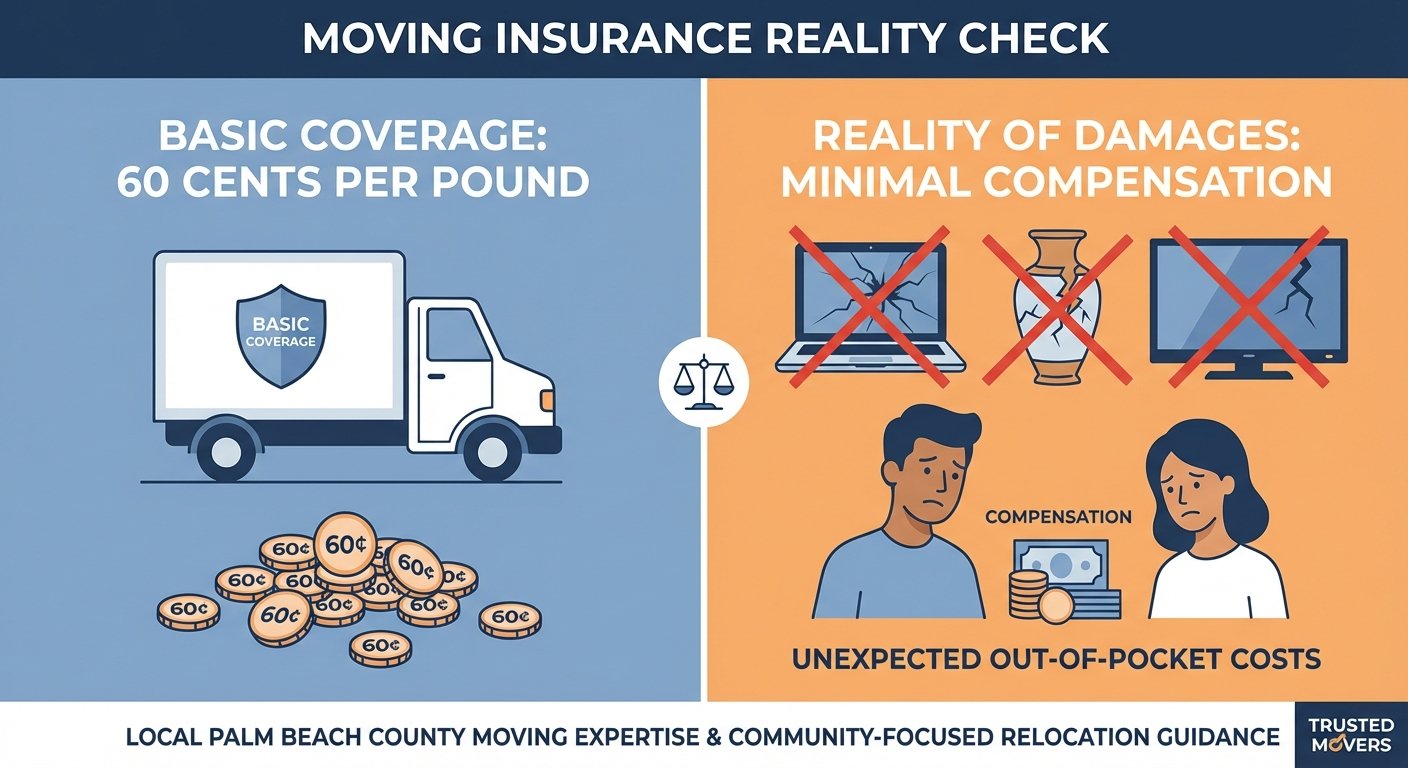
Here’s something that surprises most people: every licensed moving company is already required to provide basic liability coverage at no additional charge. This is called carrier liability or released value protection, and it’s mandated by federal and state regulations.
But here’s the catch—this basic coverage only provides 60 cents per pound per item. Think about what that means in practical terms. Your 50-pound flat-screen television? That’s covered for $30. Your grandmother’s antique dresser that weighs 80 pounds? You’d get $48 if it’s damaged or lost. That laptop computer you use for work weighing three pounds? A whopping $1.80 in coverage.
This minimal protection explains why so many people feel blindsided when something goes wrong during a move. The basic carrier liability isn’t designed to replace the actual value of your belongings—it’s a baseline requirement that provides minimal financial responsibility.
At Hall’s Local Movers, we’re transparent about these limitations upfront because we want our Palm Beach County neighbors to make informed decisions about protecting their possessions. After 23 years of helping families move throughout the area, we’ve seen how important proper coverage becomes when relocating valuable furniture, electronics, and family heirlooms.
Understanding Full Value Protection
Full value protection is the comprehensive moving coverage option that most closely resembles actual insurance. When you select this coverage, your moving company assumes liability for the replacement value of lost or damaged items, rather than just compensating based on weight.
Here’s how full value protection typically works:
- Repair: The moving company repairs the damaged item to its previous condition
- Replacement: The company replaces the item with something of like kind and quality
- Cash settlement: You receive a cash payment for the current market value of the item
Full value protection usually costs between 1-2% of the total value you’re declaring for your household goods. So if you’re declaring $50,000 worth of belongings for your move from Delray Beach to Palm Beach Gardens, you might pay $500-$1,000 for this coverage.
Many full value protection plans include a deductible, similar to auto or homeowner’s insurance. Common deductibles range from $250 to $1,000. You can often reduce the cost of coverage by selecting a higher deductible, or pay more for a zero-deductible option.
Does Your Homeowner’s or Renter’s Insurance Cover Moving?
This is one of the most common questions we hear at Hall’s Local Movers, and the answer is: maybe, but probably not as much as you think.
Most homeowner’s insurance policies provide limited coverage for belongings while in transit, but there are significant restrictions:
- Coverage typically only applies to specific perils (like fire or theft), not general damage during loading and unloading
- Your regular deductible applies, which might be $1,000 or more
- Some policies exclude coverage when professional movers are handling your items
- Coverage may be reduced to a percentage of your total policy limit
Before your move, call your insurance agent and ask these specific questions:
- Does my policy cover belongings while they’re being moved by a professional moving company?
- What perils are covered, and what’s excluded?
- What’s my deductible, and is it worth filing a claim for moving damage?
- Do I need to purchase additional coverage for high-value items?
For renter’s insurance, coverage during moves is even more limited. Many policies only cover your belongings while they’re at your rental property, not during transportation.
Third-Party Moving Insurance: An Additional Option
Beyond what your moving company offers, you can purchase third-party moving insurance from specialized providers. These policies are separate from your mover’s liability coverage and can provide more comprehensive protection.
Third-party moving insurance often includes:
- Coverage for full replacement value without depreciation
- Protection against a broader range of incidents
- Often lower deductibles than full value protection
- More straightforward claims processes in some cases
The cost varies based on the value of your belongings and the distance of your move, but for local moves within Palm Beach County, you might pay $200-$500 for comprehensive coverage on a typical household.
Companies like MoveInsure and InsureMyMove specialize in this type of coverage. However, keep in mind that filing claims with third-party insurers requires documentation from your moving company, so you’ll be coordinating between two separate entities if damage occurs.
What Actually Needs Extra Protection?
Not every move requires the same level of coverage. When deciding whether to upgrade beyond basic carrier liability, consider what you’re actually moving and its replacement cost.
High-Value Items That Need Special Attention
These items typically justify enhanced moving protection or insure belongings move strategies:
- Electronics: Large televisions, high-end audio equipment, computers, and home office setups
- Antiques and heirlooms: Family furniture, collectibles, vintage items with sentimental or monetary value
- Art and decor: Paintings, sculptures, mirrors, and decorative pieces
- Fine furniture: Designer pieces, solid wood furniture, and upholstered items
- Appliances: Wine refrigerators, specialty kitchen equipment, washers and dryers
- Musical instruments: Pianos, guitars, and other valuable instruments
For moves between condos in Singer Island or West Palm Beach’s downtown high-rises, where tight spaces and elevator scheduling create additional risks, protecting valuable items becomes even more important.
When Basic Coverage Might Be Sufficient
If you’re moving a small apartment with primarily IKEA furniture, hand-me-down pieces, and few electronics, the cost of upgraded coverage might exceed the actual replacement value of everything you own. In these situations, the basic carrier liability might provide adequate protection given your risk exposure.
The Real Cost of Moving Damage Without Proper Coverage
Let’s look at a real scenario that plays out more often than you’d think. You’re moving a three-bedroom home from Wellington to Jupiter. During the move, your dining table gets scratched, your TV screen cracks, and your dresser loses a leg.
With basic carrier liability at 60 cents per pound:
- Dining table (150 lbs): $90 compensation (actual replacement cost: $1,800)
- Television (45 lbs): $27 compensation (actual replacement cost: $1,200)
- Dresser (120 lbs): $72 compensation (actual replacement cost: $900)
Total compensation: $189 for items that cost $3,900 to replace. That’s less than 5% of the actual value.
With full value protection, you’d receive repair services or replacement value for all three items, minus your deductible. Even with a $500 deductible, you’d receive $3,400—a significant difference when you’re trying to settle into your new home.
How Hall’s Local Movers Approaches Moving Protection
As an owner-operated moving company that’s been serving Palm Beach County for over two decades, we believe in complete transparency about coverage options. We’ll never pressure you into coverage you don’t need, but we’ll always explain what protection makes sense for your specific situation.
Our approach includes:
- Clear explanation of basic carrier liability and its limitations
- Information about full value protection costs and coverage details
- Recommendations for special handling of high-value items
- Professional packing services that reduce damage risk from the start
- Careful wrapping and padding of furniture, especially important in Florida’s humidity
We take extra precautions throughout every move—from disassembly and wrapping to careful loading and securing items in the truck. Our goal is to prevent damage in the first place, making insurance claims unnecessary. But when you’re moving valuable belongings, having the right coverage provides peace of mind that complements our careful handling.
Making Your Coverage Decision: Key Questions to Ask
Before your moving day, work through these questions to determine what moving coverage makes sense:
- What’s the total replacement value of everything I’m moving?
- Do I have high-value items that would be expensive to replace?
- What does my homeowner’s or renter’s insurance actually cover during a move?
- Can I afford to replace damaged items out of pocket if something goes wrong?
- What’s my comfort level with risk versus the cost of enhanced coverage?
For most moves involving complete households with standard furniture and electronics, full value protection provides the right balance of comprehensive coverage and reasonable cost. For moves with particularly valuable items or antiques, combining full value protection with careful documentation and photographs creates the strongest protection.
Protecting Your Palm Beach County Move
Understanding moving insurance doesn’t have to be complicated. The key is knowing that basic carrier liability provides minimal protection, recognizing when your belongings justify enhanced coverage, and making an informed decision based on your specific situation.
At Hall’s Local Movers, we’re here to answer your questions about moving protection and help you understand exactly what coverage you’re getting. Whether you’re moving from a Boca Raton townhouse to a Jupiter condo or relocating your small business in West Palm Beach, we’ll provide the information you need to protect your belongings and move with confidence.
Ready to plan your move with a team that prioritizes both careful handling and transparent communication? Contact Hall’s Local Movers today for a free estimate and honest conversation about protecting your belongings during your Palm Beach County move. No hidden fees, no pressure—just straightforward advice from neighbors who’ve been moving local families for over 23 years.